Your robot breaks.Find out why.
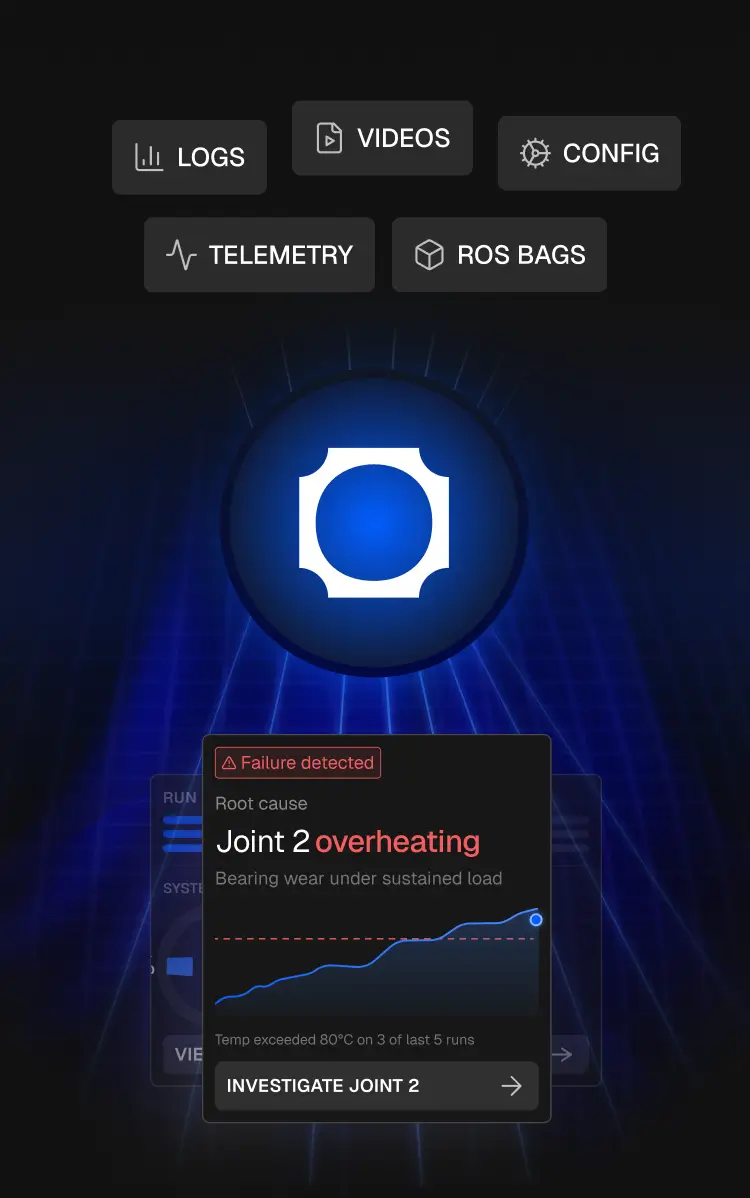
AI agents that investigate every issue across your fleet, built on a robotics data platform that captures, stores and queries every mission.
Schedule demo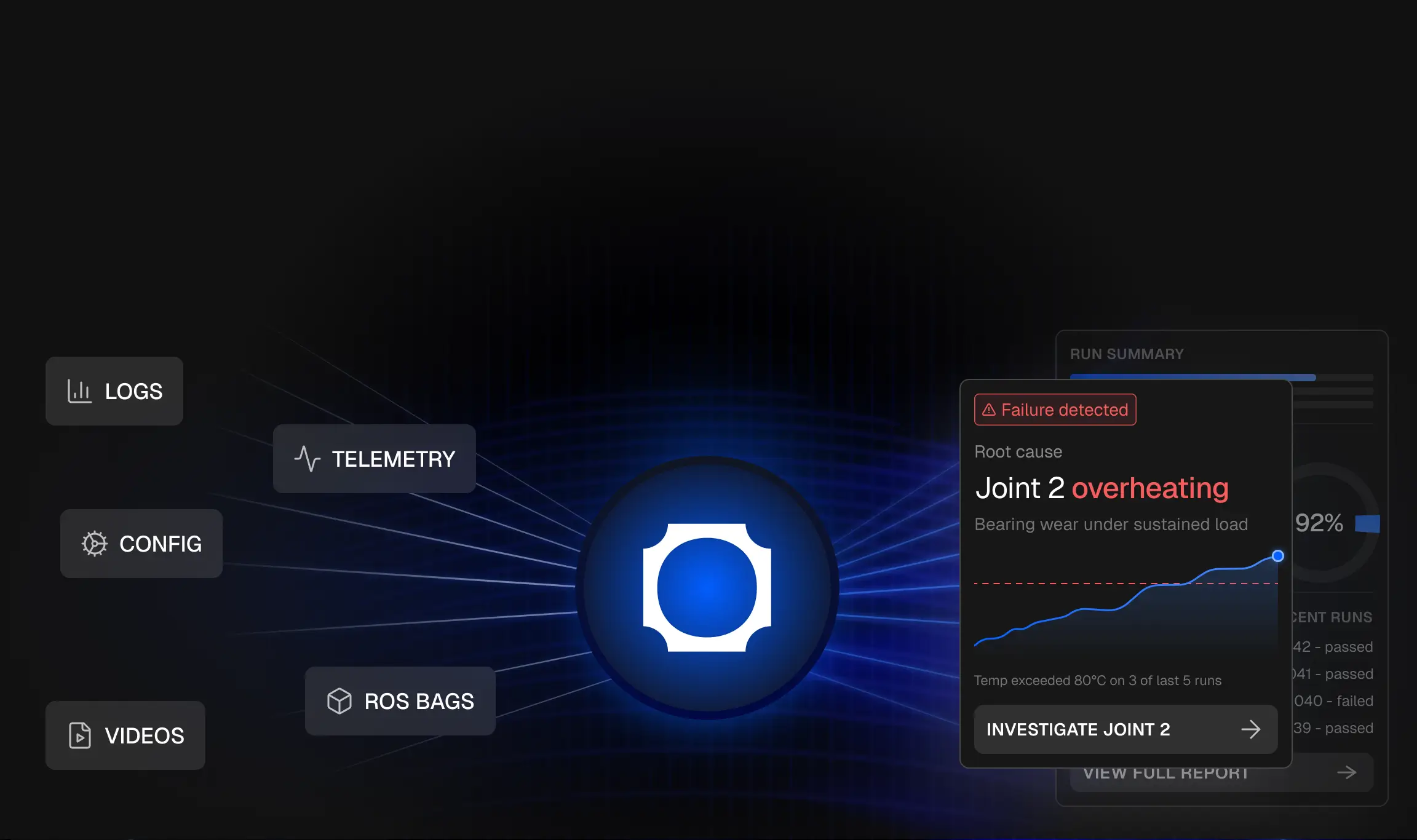
Ask questions. Get answers backed by robot data.
Anyone on your team can ask your robot data a question and get answers grounded in real missions, real telemetry, and real timestamps.


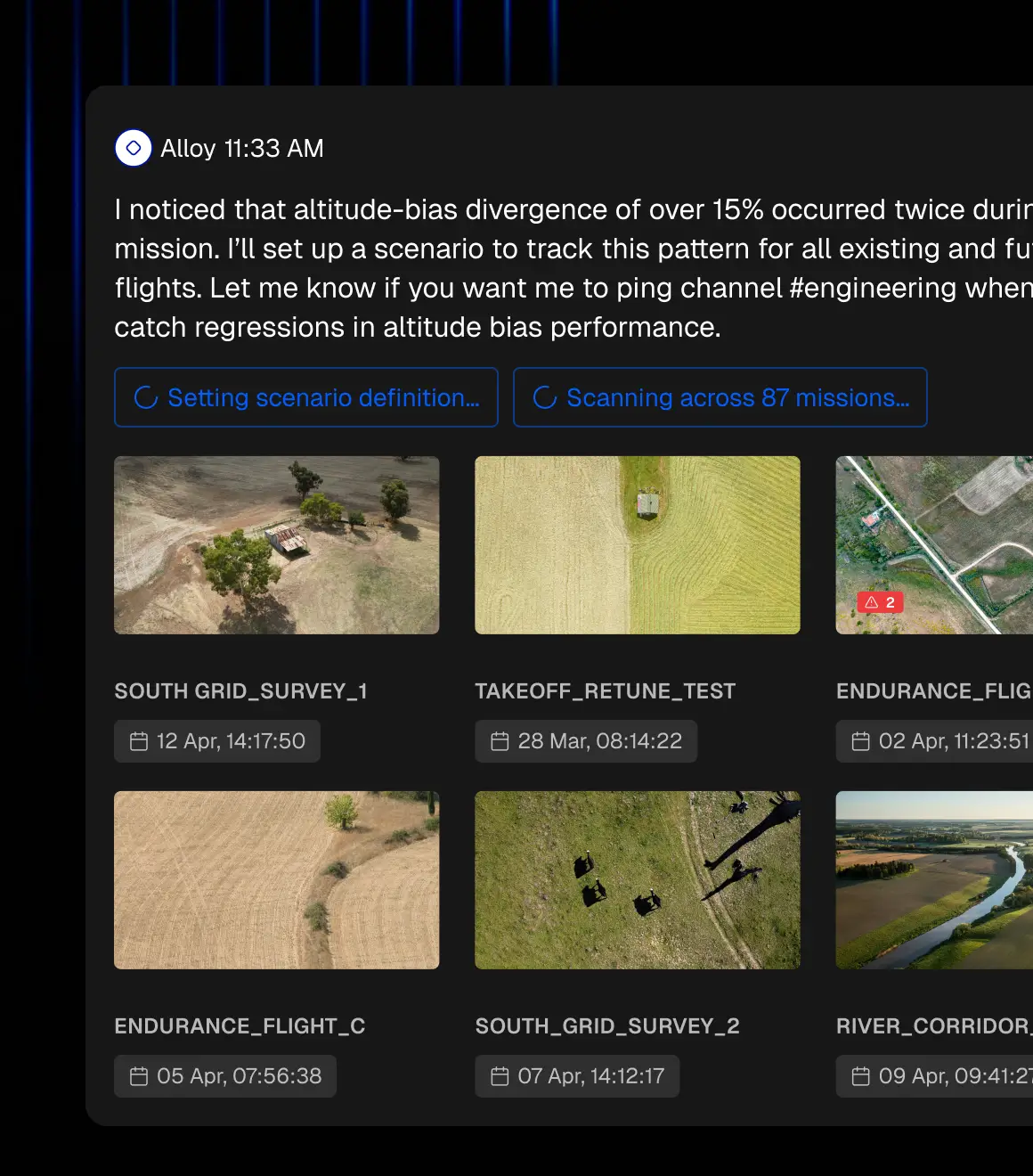
Define a pattern once. Catch it forever.
Describe what you’re looking for in plain English. Alloy scans every past mission and every future upload so you’ll know when the same pattern appears again. No need to run scripts.

Every mission, debriefed automatically.
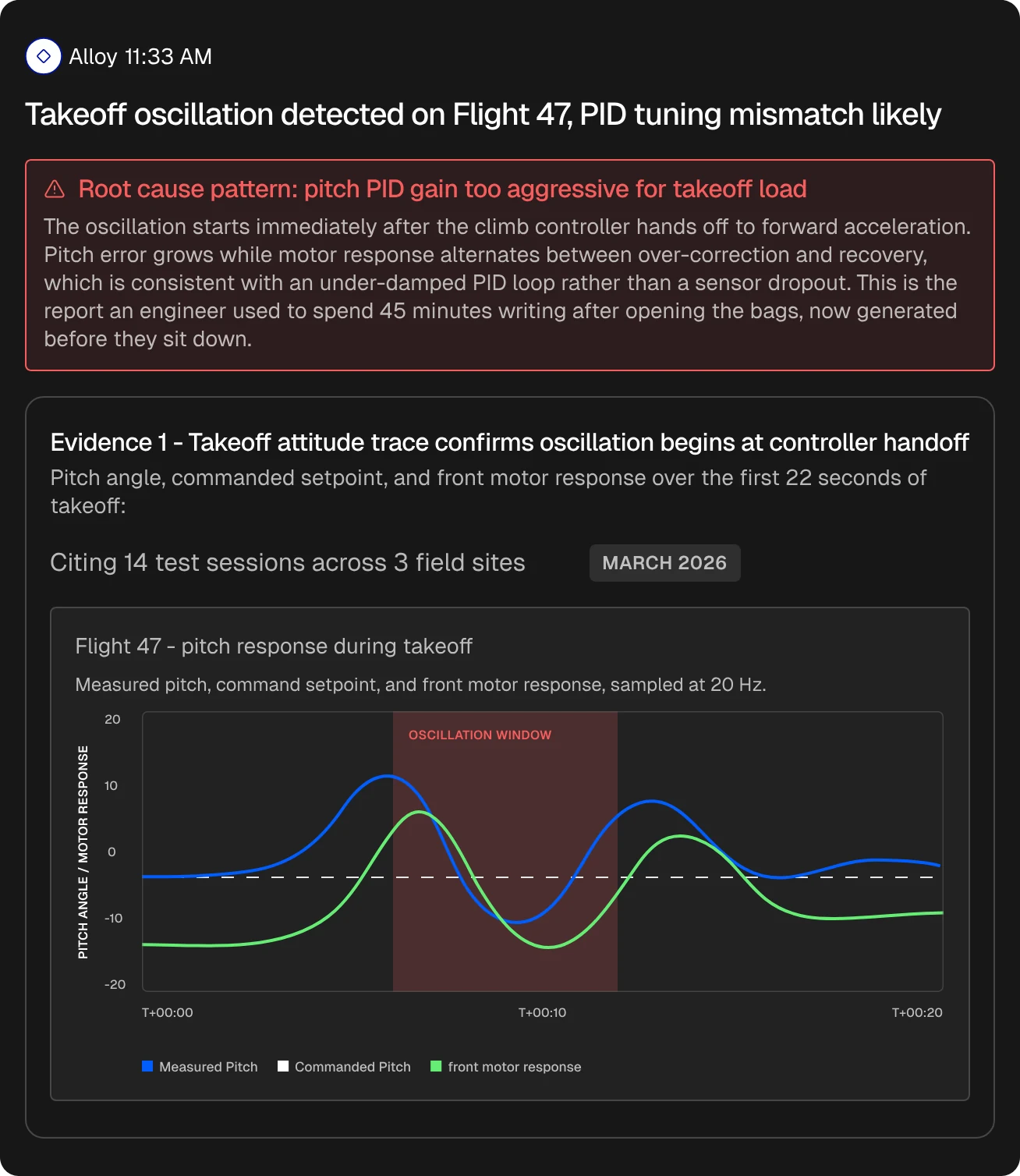
Alloy writes reports with key events, graphs, maps and analysis, all with references to underlying raw data. Answer bespoke customer requests, summarize six months of tests, or diagnose a single sensor's malfunction. Download and share the report across your team.

Keeps investigating after you close your laptop.
Alloy's agents run in the cloud. Hand off an investigation at 6pm and it keeps going overnight, split across every mission in parallel. You wake up to answers, not a queue.
- 6:00 PMYou hand it off
Ask Alloy a question, then close your laptop.
- OvernightAgents keep working
Cloud agents split the work across every mission in parallel.
- 8:00 AMAnswers are waiting
A report with findings linked to the raw data.
Validation analysis went from a full day to ten minutes.
“The business justification writes itself.”Validation Manager, Advanced Navigation
Read full case study
Support investigations went from two days to under an hour.
“It took half my job away: all the silly stuff you have to do.”Luke Reid, Robotics Support Specialist, SwarmFarm
SwarmFarm Robotics
Read full case study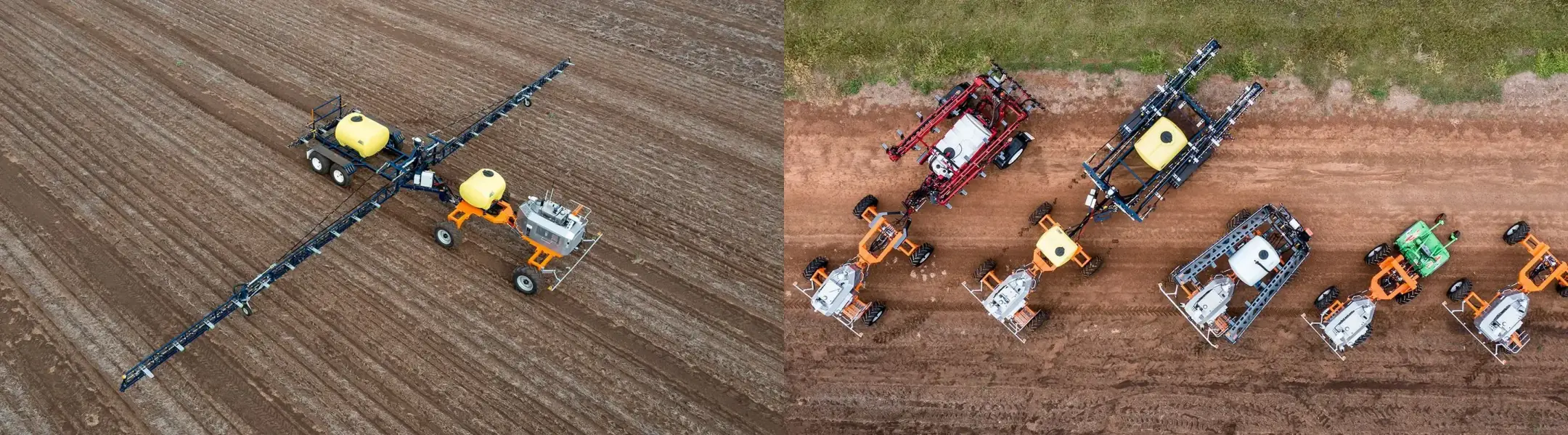
L1 and L2 robot support, automated.
“The amount of money or time that we're saving or the amount of focus that we can put into what we're best at is unparalleled.”Yan Chen, Co-founder and CTO, Andromeda
 Read full case study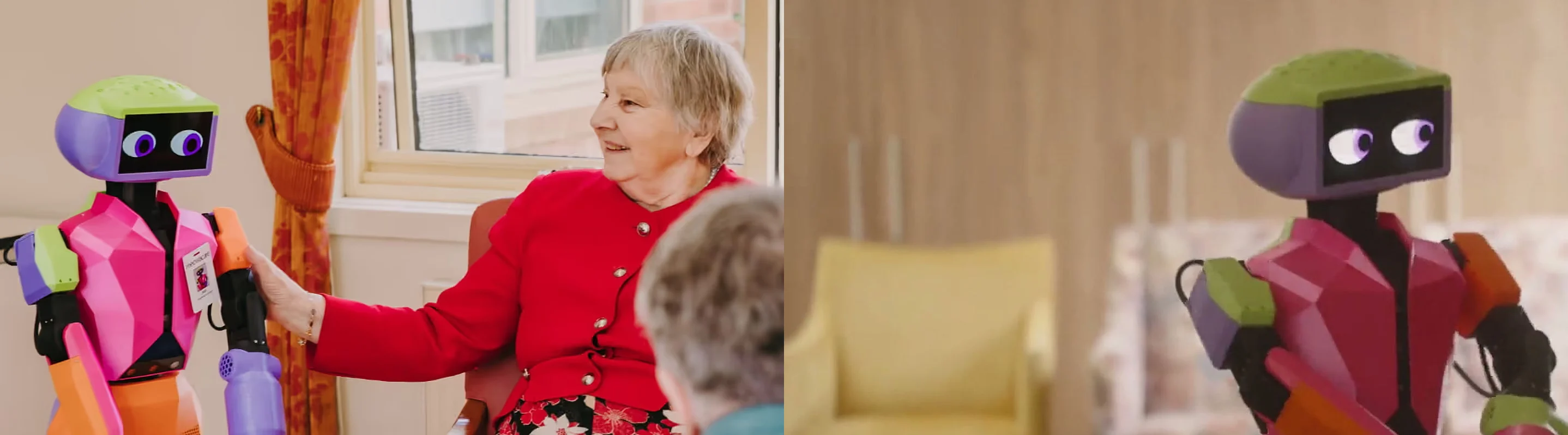
Flight data from 300+ drones turns into product fixes.
“Alloy helps us understand our flights, and then we can translate that back into how we improve the product.”David Crabtree, Founding Engineer, DroneForge
DroneForge
Read full case study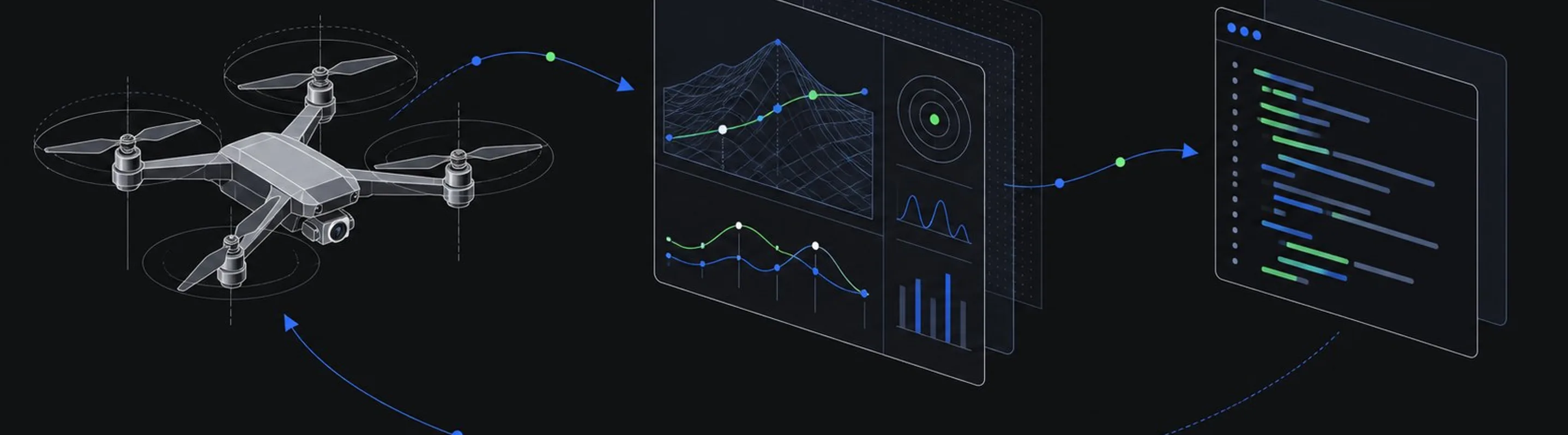
Robot data off the base station and into the whole team's hands.
“This is much easier than going through logs.”Matt Spender, Robotics Systems Engineer, Puralink
 Read full case study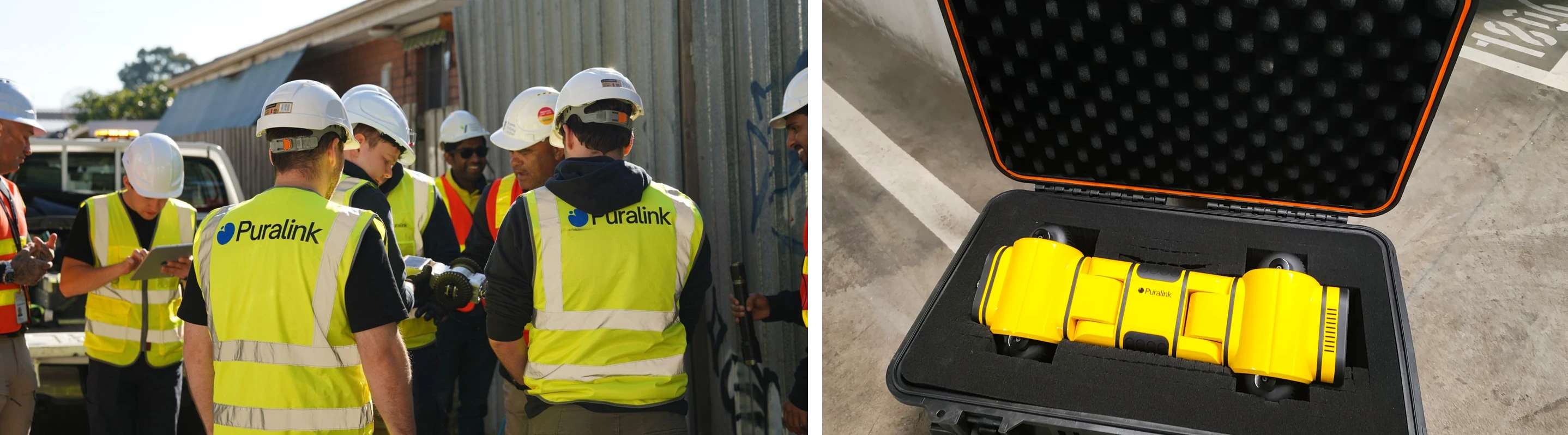
Stop stitching robot data together by hand.
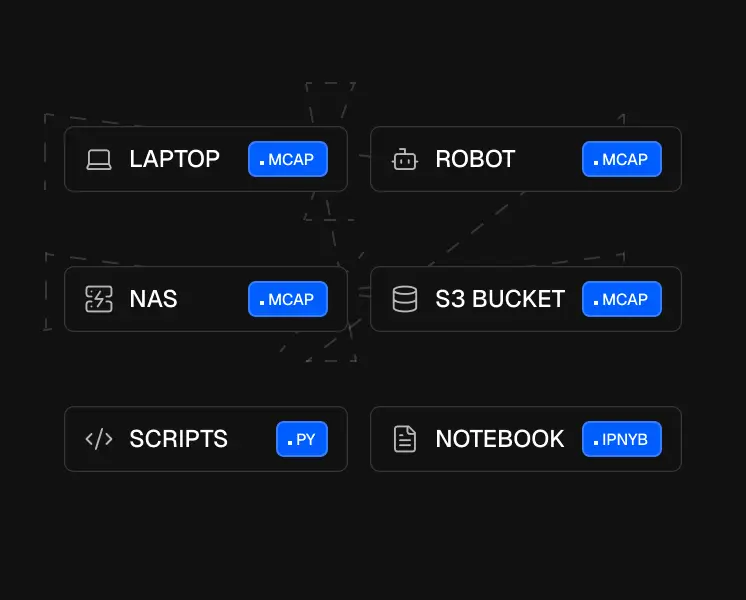
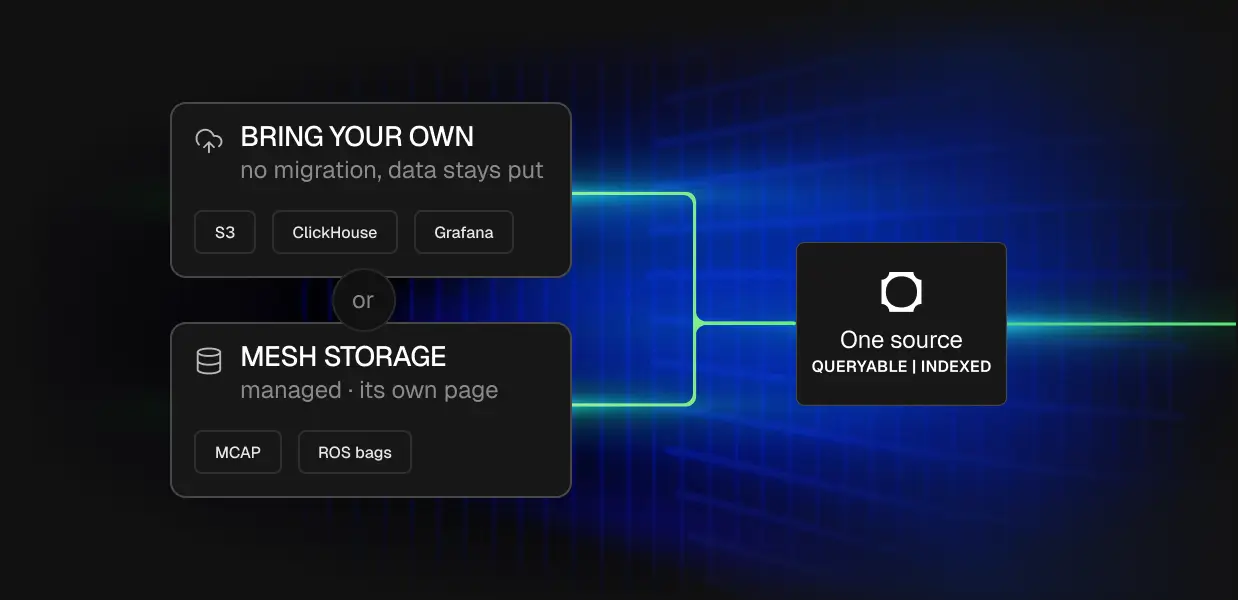
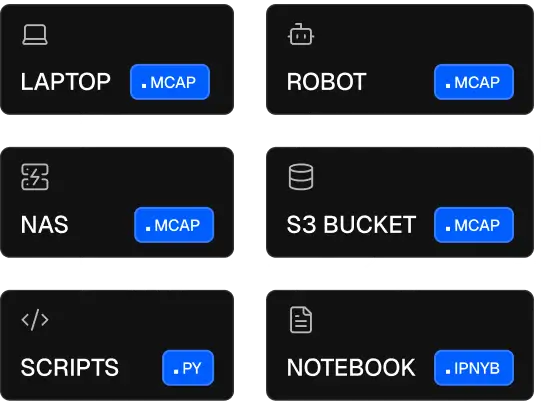
Your robot data lives everywhere: telemetry, events, logs, and recordings spread across half a dozen tools. Alloy meets it where it is: connect your own S3, ClickHouse, or Grafana, or land everything in managed Mesh Storage. Either way, it all becomes one queryable source, ready for the analysis. Underneath is a data platform built for robot data: recordings are stored as Parquet in an open Iceberg catalog and queried server-side across petabyte-scale fleet history.
Works with the tools you already use.
Alloy connects to the tools your team already uses. Query from Slack. Push findings to Jira. Pull code context from GitHub. Read from ClickHouse and Grafana. Works alongside your existing replay and visualization tools without replacing them.

Ask about your fleet from Slack
Slack

Push findings to Jira tickets
Jira

Bring code context into every answer
GitHub

Work from your team's runbooks
Confluence

Read the dashboards and logs you already have
Grafana



Query robot data where it already lives
Amazon S3 · Google Cloud Storage · ClickHouse · Databricks · NAS

Read MCAP and ROS bags without converting
MCAP · ROS · ROS 2 · Parquet · CSV · ArduPilot, and other formats

Use Alloy from your coding agent
Claude Code · Codex · Cursor, via MCP
Give your coding agent superpowers.
Codex and Claude Code are great for writing code. They can't ingest MCAP files, they burn through context before comparing 10 missions, and they forget everything between sessions. Alloy holds your entire fleet in context, remembers every investigation, and understands your data natively.

Claude Code
Claude Enterprise
~/code/usealloy.ai/
>> accept edits on (shift+tab to cycle)
Your data. Your control.
Data encrypted in transit and at rest.


Sensitive fields can be redacted on the device before data ever leaves your network. Teams in defense, medical, and compliance-restricted environments use this to stay within regulatory boundaries while still getting full platform capability. Alloy is aligned with NIST SP 800-171.
What robotics teams ask before they start
What is Alloy?
Alloy is the AI Robotics Engineer. When a robot fails, Alloy finds out why in minutes: its agents search the logs, telemetry and recordings for that incident and answer with the evidence attached. Ask in Slack, Jira, the Alloy app or your coding agent.
What results do teams get with Alloy?
Andromeda used to give one engineer the whole help desk; now Alloy automates its L1 and L2 robot support across around 200 conversations a week. SwarmFarm's support investigations went from a day or more to under an hour, so it's scaling a fleet of close to 300 robots without hiring more support engineers. Advanced Navigation cut validation analysis from a full day to ten minutes.
How do I know the answers are right?
You don't have to take Alloy's word for it. Every finding shows its working: which mission, which signals, which time window and how it got there, one click from the raw data. When the data can't support a conclusion, Alloy says what's missing and hands the investigation to an engineer with the evidence attached.
Will Alloy understand our robot, or give generic answers?
It knows your robot, not a generic one. Alloy reads your topic names, code, tickets and past investigations, and looks across your whole fleet, not just one ticket. At Andromeda, an issue that looked like a one-off on one robot turned out to be a bug on several robots at different times, and nobody knew it existed until Alloy connected them.
How much of our team's time does it take to set up?
Almost none: we do the setup. You give us access to the robot data you already have, and our engineers connect it and run Alloy's first investigations on your recent issues. No new project for your team and no change to how your robots log, so you're getting time back from the first week, not spending it.
Will it work with our data formats?
Yes, including the messy ones, with no conversion scripts. Alloy reads ROS bags, MCAP, controller logs, CSV, Parquet and custom binary formats, even when schemas change between firmware versions. Your data stays where it is: connect S3, ClickHouse, Grafana or Jira, or use managed Mesh Storage.
What if our robots can't stream data?
You still get answers. Alloy's edge agent stores recordings on the robot and uploads them when it's connected. On low-bandwidth links, send light telemetry and pull back only the slice of the recording you need once an issue is flagged.
Where does our data live, and who controls it?
Wherever your requirements say. Alloy runs in our cloud by default, or privately in your cloud or on-premise when data can't leave your environment. You approve the AI models, you own every output, and sensitive fields can be redacted before they leave the robot. SOC 2 Type II audited, supports HIPAA requirements, and aligned with NIST SP 800-171.
Why not use Claude or build it ourselves?
You can. Claude wired to your logs works for one engineer. Then someone has to maintain the pipeline, work around context limits and answer everyone else's questions, and that someone is usually your best engineer. "We build robots. We don't want to build diagnostic websites," says Tom Brodie, Head of Autonomy at SwarmFarm.
How is Alloy priced?
Less than one robotics engineer, and Alloy works across your whole fleet, around the clock. Pricing is usage-based with no per-seat fees, so you pay for the investigations Alloy runs, not for logins. Try it free, or get an estimate for your fleet.
Ask a question here